The Double Edge of Quantum Computing
Originally an invitation by Tina Rivers-Ryan to ArtForum, this previously unpublished essay discusses the implications of advancements on quantum technology on our perception of the world. I write about the current state of quantum computers, the “quantum arms race” and some of my artworks that touch on these topics.

‘remiQXing’ (2022), Fiumano Clase, London.
The double-edge of quantum computing is one of the themes I explored in Ent- (2022). On one hand quantum computing is intricately bound up with the military, extraction and surveillance. On the other hand, the underlying quantum physics suggests a radical, queer, plural, shapeshifting potential.
Unlike digital computers that process information step-by-step via ones or zeros in pursuit of one “true” solution, quantum computing is a new type of technology that utilises the non-binary nature of quantum physics to compute information in parallel, exploring all possibilities at once. Quantum mechanics—which describes the plural and delocalised behavior of microscopic matter such as atoms and electrons—gives me both hope and dread. Quantum’s non-binary nature is expected to allow future full-scale quantum computers to run at unimaginable processing speeds, enabling them to rapidly solve complex problems, such as the factorisation of large numbers into their primes, that no digital computers could ever determine.¹
After researching quantum information science for five years as a postdoctoral fellow, and now continuing to explore its implications for art, I have no doubt that quantum technology will cause a paradigmatic shift in the way we see the world and our place in it. The only uncertainties I have is when this will happen and how it will impact self, society, and nature. This is why it’s important to have conversations around its impacts now—as private and public organisations invest billions into the so-called “quantum arms race”—before it is fully developed.² Unfortunately the general public has little understanding about quantum science, and consequently there are very few ethical discussions happening. While I don’t want to instrumentalise art, I see an opportunity for the critical art community to generate important discourse around the impacts of these new tools. When used creatively, quantum has the potential to queer the rigid structures of algorithmic computation. The quantum queering of binary computation—an avenue I’ve been exploring in my practice—involves holding multiple seemingly contradictory possibilities, temporalities or realities as “true” simultaneously, rather than collapsing back to one fixed way of perceiving the world.³

Still from ‘remiQXing’ (2022), Libby Heaney.
Quantum will bring about an unprecedented understanding of complex systems. When science progresses, capitalism usually follows, finding new ways to extract value and exert control. Quantum surveillance capitalism might soon be with us, as technologists strive for quantum machine learning—ontologically different and exponentially more powerful compared with digital machine learning—and scientists propose quantum modes of mind reading based on current experiments with TKTK. It sounds like science fiction, but as technology catches up with theory, it will soon be with us.
In 2022, I explored the intersection of capitalism, quantum, and art in two video works: QX Extended Advertisement and QX Product Launch Video. Both are glitchy, slimy, semi-fictional narratives weaving real ubiquitous marketing speak with (then) fake narratives of artwashing. QX Extended Advertisement utilizes real hyperbolic language (“make a quantum leap with your business”) of big tech companies and start-ups working on quantum computing, along with my own fake hyped-up slogans about the promises of quantum within art. QX Product Launch Video parodies the language and enthusiastic vibe of IBM’s Quantum Summit Keynote video positioning my fictional company QX as the world’s first to use immersive quantum art to extend modes of surveillance capitalism. Sweeping views of shiny digital renders of quantum computers—made in the 3D software program Blender—are overlayed with ghostly glitches created through Python code and IBM’s “Qiskit” library on their publicly available quantum computers. This fiction became a reality when later that same year, a CEO of a quantum start-up—majority owned by a well-known nuclear weapons manufacturer—reached out to say he was starting a “quantum arts company”…⁴

QX Extended Advertisement (2022), arebyte Gallery, London.
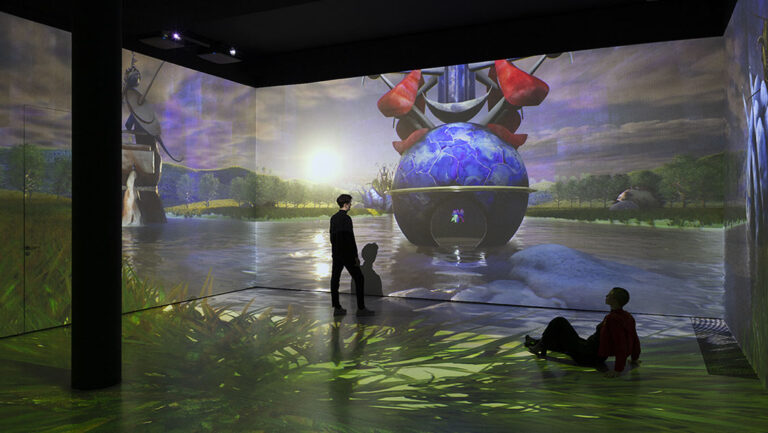
Current quantum computers are still prototypes, known as NISQ (noisy, intermediate, scale quantum) computers. Some small quantum computers—5 to 128 quantum bits (or “qubits”)—have been publicly available to use via IBM’s cloud computing platform since 2019, when I started exploring how their plural, nonlinear timelines and multiple possibilities could rework images, sound, video, and 3D real-time animations. For my 2022 immersive environment Ent-, I used IBM’s NISQ computers to program 15 qubit entanglement: a uniquely quantum phenomena where all qubits lose their own identity and act as one layered multiverse collectively and simultaneously occupying different possibilities. I then used this plural and interconnected entanglement data to create various animations of scans of a watercolor series of hybrid creatures. Hybridity is a key feature of quantum reality, as atoms are fields of potential holding all contradictory ways of being at once. When audiences enter Ent-, they are immediately destabilised by the floor projection, becoming fluid like atoms and entangling with the work. The piece—loosely inspired by the central panel of Bosch’s Garden of Earthly Delights, yearTK, as a site between heaven and hell—starts in front of a render of a quantum computer high in the sky—a new god, perhaps. As it opens, it envelops the audience before falling apart, revealing pulsating gold tentacles and ghostly quantum glitches of creaturely body parts flashing in and out of being. Ent- therefore highlights the unbounded, intertwined nature of life and machines, inviting audiences to embody the queer potential at the heart of quantum.
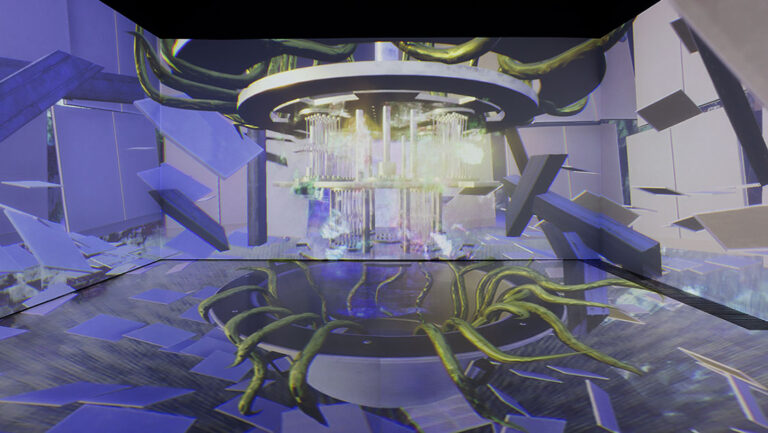
Ent- (2022), Light Art Space, Berlin.
While NISQ computers are good for recreating phenomena from quantum physics like entanglement, they cannot yet solve real world problems that no digital computer ever could. To that end, major governments and technology companies like IBM, Google, and Microsoft are competing to build the first full-scale quantum computer capable of achieving such a feat—giving them the much-lauded quantum advantage. Often pitting the USA against China, the media has dubbed this the “quantum arms race,” given that such machines might be able to crack all currently used encryption, including blockchains, as well as model and create new generations of weapons, materials, and energy resources.
Since 2024 this race has really gained speed. Late in 2024, Google announced it had achieved quantum advantage through a clever display of quantum error correction—one of the two missing ingredients for full-scale quantum computing.⁵ In February of 2025, Microsoft announced that it had built “the world’s first quantum processor powered by topological qubits.”⁶ Unlike Google or IBM’s systems, topological qubits naturally protect the delicate non-binary states inside a quantum computer and are based on a new state of matter comprised of braided quasi- (or virtual-) particles in flat 2D space.