
Quantum Queries: Quantum Concepts Explained
A series of summaries on the essential concepts of quantum physics, as explained by Professor John Goold and Daniel Cavalcanti.

Still from slimeQrawl, Libby Heaney, 2023.

Daniel Cavalcanti
Lead Quantum Information Researcher, Algorithimiq
What is entanglement?
Two people, one in Tokyo and one in London, undergo the same questionnaire. They have no idea what questions they will be asked. They cannot talk to each other. In fact, they don’t even know of each other’s existence. Yet they give the same answers to all the questions. This strange situation occurs in quantum physics. Entangled particles give the same results when subjected to the same measurement, no matter how far apart they are from each other.
What is superposition?
Look through a glass window. What do you see? The outside world? A reflection of yourself? A superposition of both? Quantum systems can be in a superposition of different configurations: being here and there, moving left and right, or being one colour or the other simultaneously…
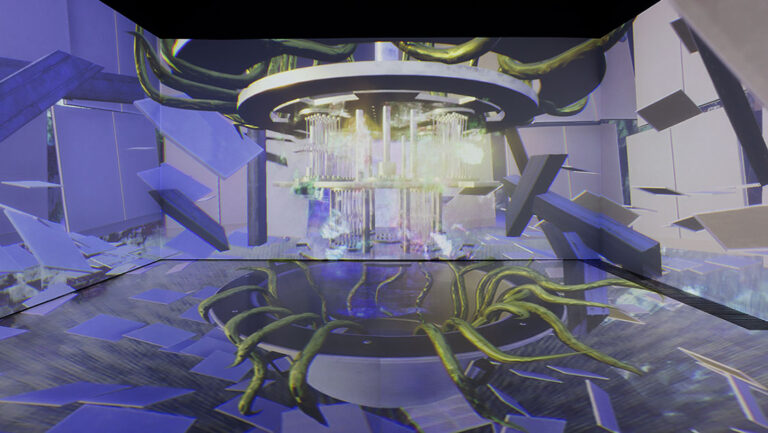
Installation shot of Ent-, Libby Heaney, 2023.
What are quantum bits?
Bits are the basic unit of information. Every email you read, music you listen to or film you watch is a stream of 0s and 1s. Information can also be encoded in quantum systems, such as atoms or photons. And because they can be in quantum superposition, they can encode a 0 and a 1 simultaneously.

What is quantum computing?
Computers are devices that store and process information in the form of bit strings (sequences of 0s and 1s). Internally, these bits correspond to two distinguishable hardware configurations, like two different levels of current in an electrical circuit. A quantum computer also stores and processes information, but unlike standard computers, it uses quantum systems such as atoms or electrons to encode information. It can thus use quantum properties such as superposition or entanglement to solve problems that are infeasible even for the best supercomputers. For instance, quantum computers could provide great benefits in healthcare with new drugs, or agriculture with more sustainable fertilisers, or perhaps even help us in the quest for a more sustainable world thanks to new materials and better batteries.
What is quantum measurement?
What is your name? What is your name? What is your name? I hope you gave the same answer every time. Quantum systems are not so coherent and can give different answers for the same measurement. In quantum physics, although we cannot predict with certainty the results of a measurement, we can tell the probabilities of occurrence. But this does not mean that we have no control over quantum systems. In fact, scientists can design experiments so that the answers are not completely random, but the probability of the sought answer is increased.
What is quantum speed-up / quantum advantage?
A transporter must deliver parcels to N different houses. What is the shortest route they can take? This everyday problem turns out to be astonishingly hard to solve even for the best computers: they basically have to look at all possible combinations of routes. Similar problems involve finding the key to an encrypted message or the most stable configuration of a molecule. However, a quantum computer that explores the quantum superpositions of the different routes can arrive at the optimal solution much faster.

Professor John Goold
Associate Professor of Physics, Trinity College, Dublin
SFI-Royal Society University Research Fellow
Director of the MSc in Quantum Science and Technologies
What is entanglement?
Entanglement is a radical feature of quantum systems. It occurs when the principle of superposition is applied to multiple quantum particles. For instance, if two quantum particles – like atoms – interact at some point in time, and then fly off in separate directions across space, entanglement prevents them from acting individually. Measurements of properties of one particle will affect outcomes on the other particle even if they are really far away from each other. This quantum phenomenon is exploited routinely in quantum technologies.
What is superposition?
Superposition is a unique feature of quantum mechanics. It allows objects to be in more than one physical state simultaneously. For instance, if you are walking and face a split in the road you will either take the right or left path. However, quantum systems like atoms or photons can take both routes simultaneously.
What is a qubit?
A qubit is to quantum information processing what a bit is to classical information processing. Fundamentally when you process information and send messages they are encoded in ones and zeros called binary. A bit can be either zero or one. A quantum bit also has those logical states but it can also be in many superpositions of both zero and one at the same time. So qubits are what we manipulate when we do quantum information processing. They can be encoded in physical systems like atoms and photons the same way bits can be encoded in transistors and electronics.
What are quantum measurements?
Measurements are extremely important in quantum mechanics and are responsible for why its such a radical departure from other physical theories such as Newtonian mechanics. Usually when we think about probabilities, for example the population of Dublin today, we cannot give an exact number because of our ignorance. So we could really only say with some probability what the exact population would be. However, at an instant of time a precise number of people in Dublin does exist. On the other hand, when a quantum system is measured you get an outcome which is fundamentally random even if you knew the state it was in before the measurement. Even more radical is that the state of the quantum system following your measurement of it is fundamentally and irreversibly influenced by the outcome of the measurement you make.The act of measuring changes the ontological state of reality.
Quantum Information
Information as a real scientific concept is really quite new and is due to a famous engineer called Claude Shannon about 70 years ago. The idea is to equate information or acquisition of information to a form of being surprised. For example there is less information in someone telling me the weather is going to be crap in Dublin tomorrow then if someone tells me that it will be 35 degrees since I will be more surprised at the latter. This idea of abstracting information and learning how it is transported can be generalised to quantum systems which deal in quantum logic and this is quantum information.