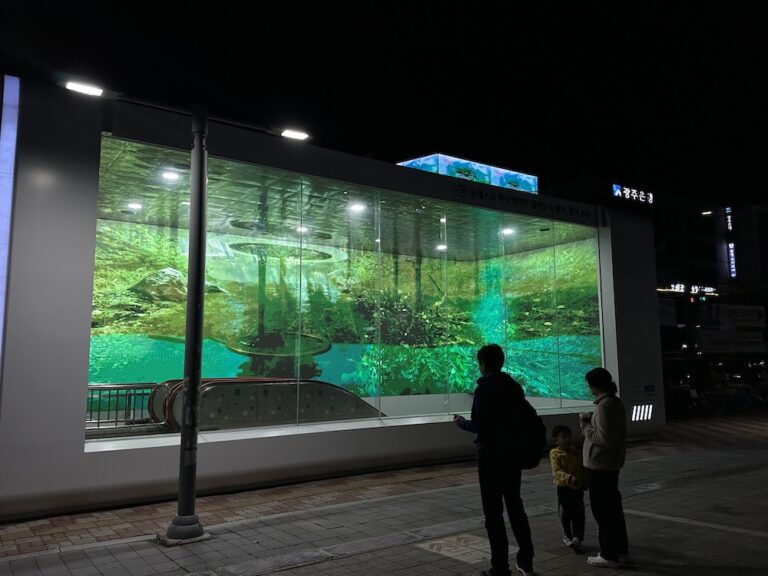
Showings not Telling: Quantum Materiality and Non-linear Time
Reflecting on my works Q is for Climate (?) (2023) and Qlimate (2025), I discuss how quantum materiality allows us to experience non-linear time directly and how it could be a source of hope in our fast-paced capitalist society.
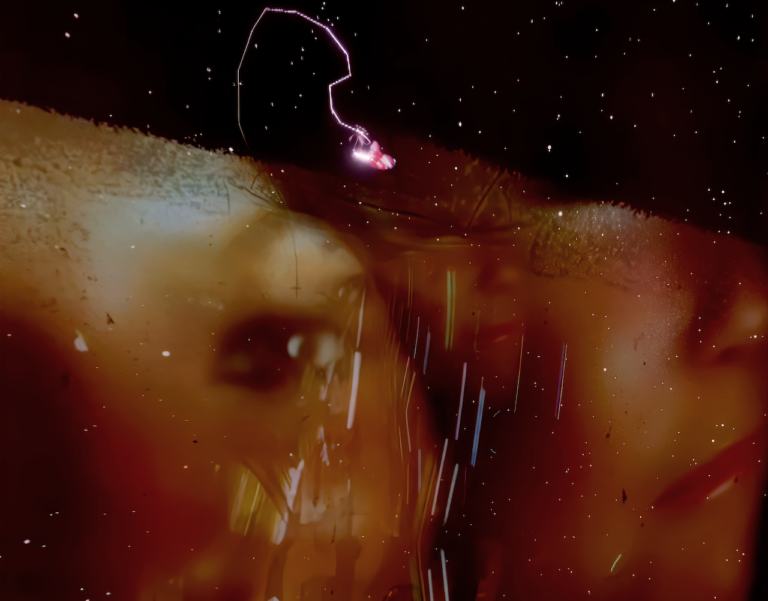
Still from Heartbreak and Magic, 2024. The work ends with finding my sister in the multiverse.
Nonlinear time is important to me, because if other timelines exist – if the multiverse is real – maybe there’s a chance my sister is still out there, somehow, somewhere.
I didn’t always believe in a web of times.
My science training indoctrinated me into linear time at a young age: forward, progressive, unfolding according to rational sequences and governed by the reductive logics of the scientific method. And sometimes I still feel it as my body being dragged into the seemingly inevitable future of increasing far-right facism and climate chaos.
Under this so-called “arrow of time,” inherited from 19th-century thermodynamics, the world is organised into cause and effect; birth, life and death; command and control. Time is a line, and the line always moves toward mastery, domination by certain sectors of humankind while increasing entropy and chaos for everything else.
But is time really this straight forward?
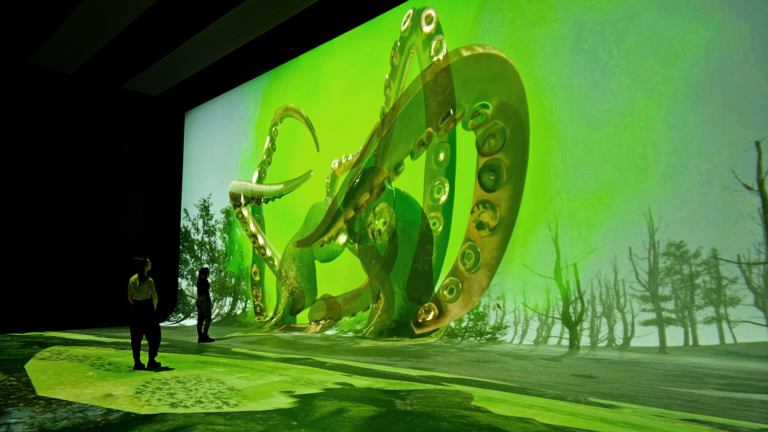
Q is for Climate (?), 2023 at NXT Museum, Amsterdam, 2023.
By contending with the meaning of life after my sister died as well as through my art practice with quantum materiality, I understand that linearity is a fiction rather than a material “truth”.
Quantum materiality refers to any physical substance that displays non-trivial quantum effects:
– superposition: the ability for one thing to exist in multiple contradictory states simultaneously, and
– entanglement: a nonlocal (distant) connection between two or more things so strong it becomes impossible to retrieve an isolated individual.
Time through entanglement and superposition dissolves the presumptive linearity of past, present and future.
Quantum materiality reveals temporalities that are multiple, layered, intersecting, and flexible: a multidimensional time of interferences rather than a single progression: an extra-dimensional web of possibilities versus a single railroad track.
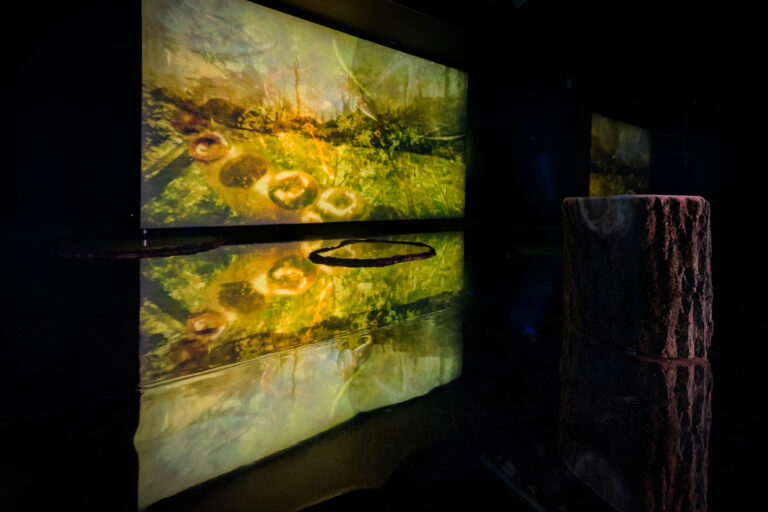
Q is for Climate (?), 2023/25 at Belvedere 21, Vienna, 2025.
In the art world we often talk about non-linear time, yet we still rely on linear, narrative formats as the medium: a video with a beginning, middle, and end; a lecture delivering a sequential argument.
I do this myself – it’s how our western brains make sense of the world.
But what truly interests me is how quantum temporal structures can be seen and felt in my artworks; not just theorised, but experienced.
Experiencing non-linear time is important as it opens our bodies and minds to alternative ways of being and this gives us hope.
My installations, videos, and interactive works use quantum computation as a metaphor, a method and a medium. For me, quantum is both a technical and conceptual apparatus for generating non-linear temporal experience.
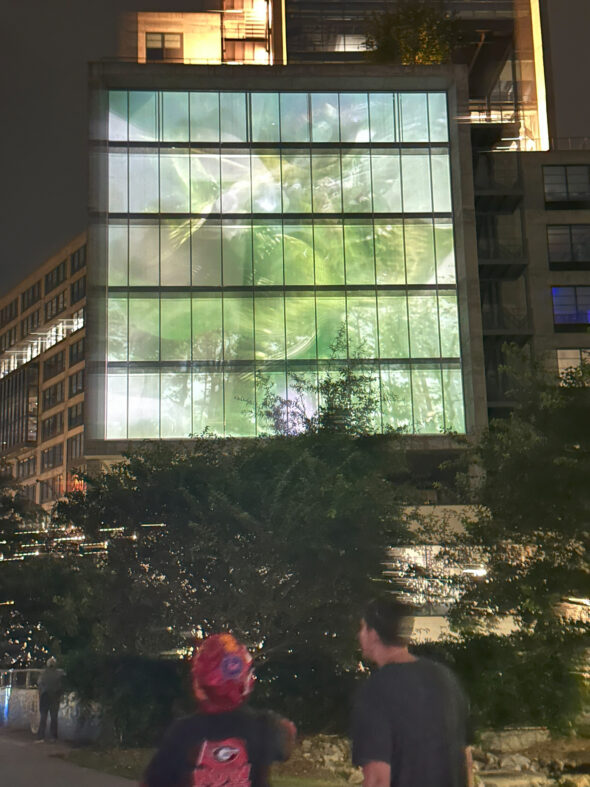
Q is for Climate (?), 2023/25 at 725 Ponce, Atlanta, 2025.
Q is for Climate (?) (2023) contrasts the linear time found in classical (non-quantum) time-based art with the non-linear time of quantum media.
In it, I wrote my own quantum-video-editing algorithm to entangle multiple clips of rendered imagery into wave-like overlays. Thirty-two videos – each controlled by a different quantum timeline – are always present, modulating and interfering with one another according to the entangled logics of a five-qubit IBM processor.
As I wrote here, this process “produces shifting superpositions of landscapes that refuse to settle into a single authoritative narrative.”
This refusal matters.
Quantum systems never grant the comfort of a stable “now.”
Instead, they produce what I think of as quantum temporal liquidity: a constant layering of paradoxical moments and quantum drifts across simultaneous possibilities.
Quantum temporalities stand in stark contrast to what Byung-Chul Han calls the “eternal present of contemporary digital capitalism”.
Every morning, over my first coffee, I scroll through Instagram as I slowly adjust to being awake. I enter what Han describes as “an unstructured time of pure immediacy.” I am no longer present in my body. Durations collapse and everything becomes a stimulus, another notification (“Who’s it from? What do *I* need to post today?” …if I even have the energy to do that…).
I am pulled outside myself rather than engaging in the deeper reflection I need particularly at that moment.
Unlike quantum time, Han’s present has no depth and no horizon. In his words, “the acceleration of life leads paradoxically to temporal stagnation.” Like my finger caressing a screen, I am stuck on a flat surface with no future and no real depth. What’s missing is layers – moments to pause, journeys inwards and just being – rhythms, higher order patterns, cycles and the ability to inhabit more than one temporal register at once.
Quantum temporalities, at least as I use them, restore that depth. They provide a counter-logic to the sharp, glossy, surveillance of the feed and open up new imaginaries (if we can call it that when dealing with quantum) around the nature of existence itself.
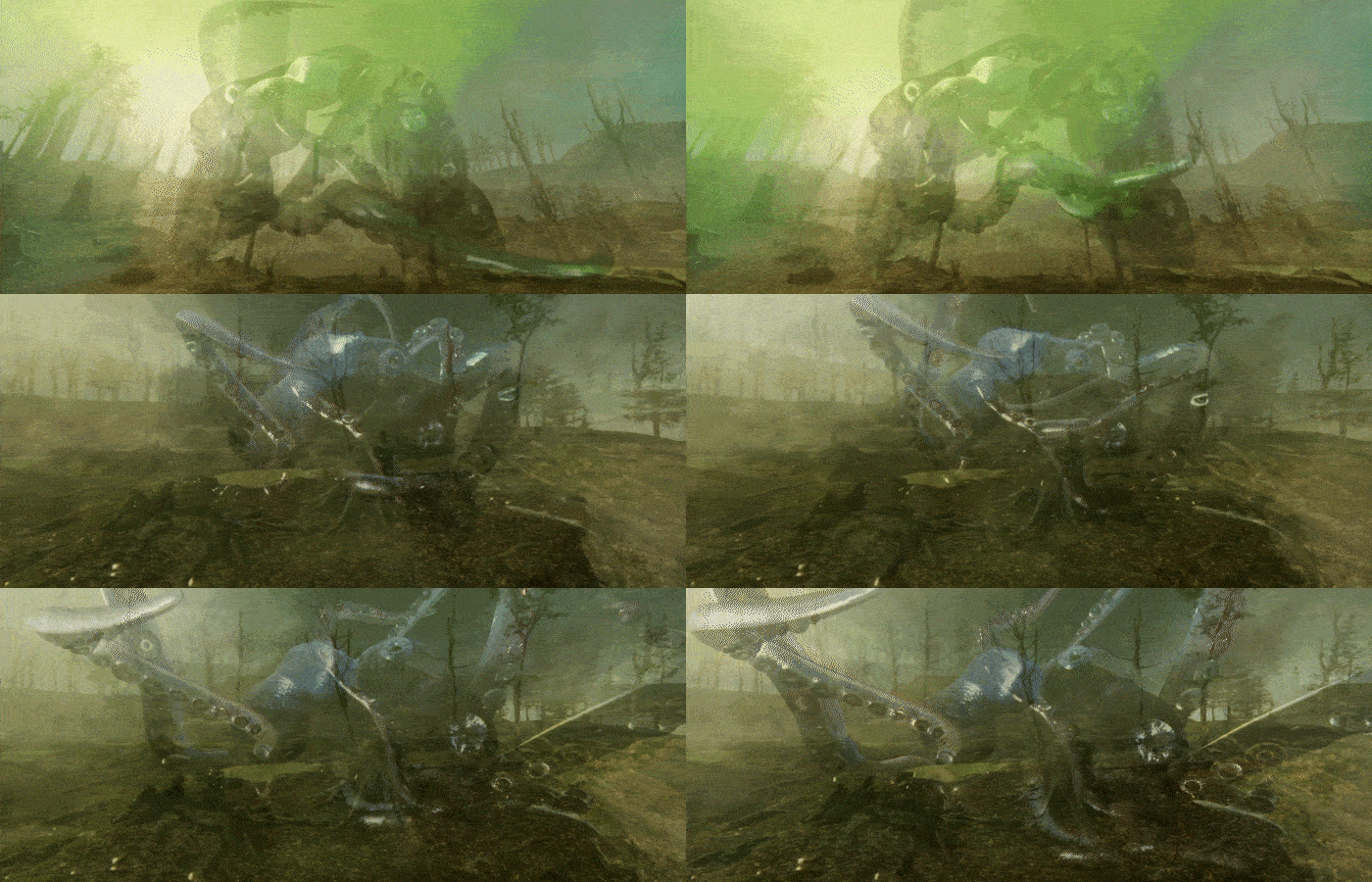
In an adaptation of Q is for Climate (?), called Qlimate (2025), which is in Patterns of Entanglement curated by Alex Estorick at NEORT++, Tokyo, the wave-like superpositions of all possibilities enact this entangled “now”. You never see a single landscape fully.
Instead, each scene is haunted by all others: barren terrains, black ooze, industrial gases and toxic lakes, fold into views of lush green landscapes inspired by European re-wilding. Coherent quantum entanglement data drives these continuous, shape-shifting multiplicities. Rather than a linearly edited montage, the work becomes a temporally entangled image.
For many viewers, the visual outcome is unsettling or jarring because it shows what non-linear time actually looks like: blurry, layered, always becoming, looping, haunted and haunting.
Moreover, the aesthetic resists documentation – crisp images merge into a productive blur.
Machines cannot categorise what exists.
But by slowing down, by feeling our way through the artwork, we can sense its depths, its alternative perspectives, the multiple horizons, and the entangled durations flowing beneath the surface.