I contrast Karen Barad’s hybrid classical-quantum theory of Agential Reality with quantum-only forms of experience and write about how approaching experiences with a beginner’s mindset can be similar to art based on quantum-only ontologies – a non-narrative, unresolved state of being.
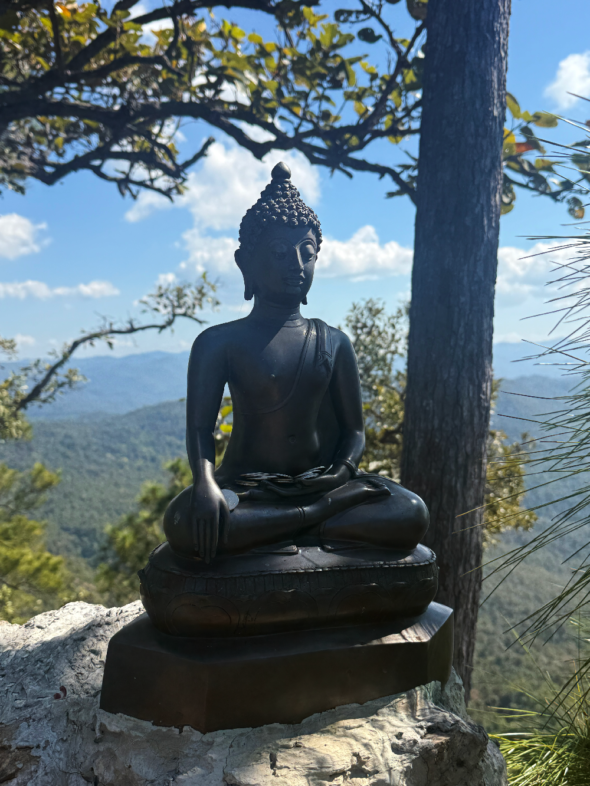
I was recently in Thailand, for a month of inhabiting my body through yoga, hiking and swimming. And isn’t it funny how when we let the mind rest, things we’ve been circling for a while start to seep into conscious awareness? While walking in nature or reflecting after a long pranayama, I started to gain further clarity on certain aspects of my practice.
Over the next few newsletters, I’ll be writing about this.
About quantum-only ontologies, quantum-only forms of experience and what they mean for art and the world.
By quantum-only, I mean ontologies where classicality (the macroscopic world) never emerges.
I have been working with quantum materiality through publicly accessible quantum computers since 2019, gleaning traces of superposition and entanglement as if they had never collapsed, as if classicality had never emerged.
This quantum-only realm is a field of fluid possibility, a little like when our minds stop chattering and we truly embrace the vastness of the present moment.
However, quantum-only realities do not behave in ways that align with our regular habits of thinking, seeing or narrating, because they do not permit representations of any kind.
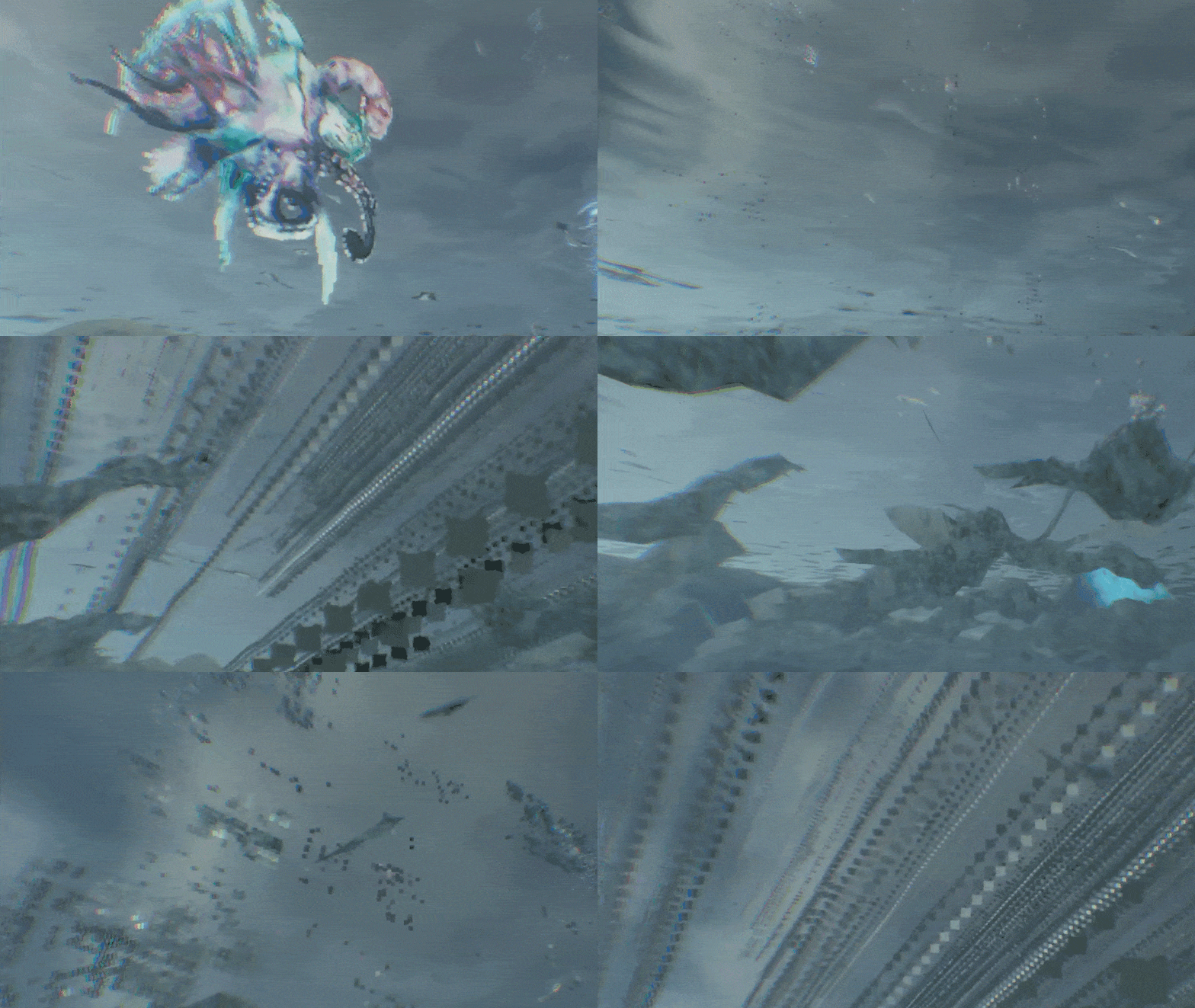
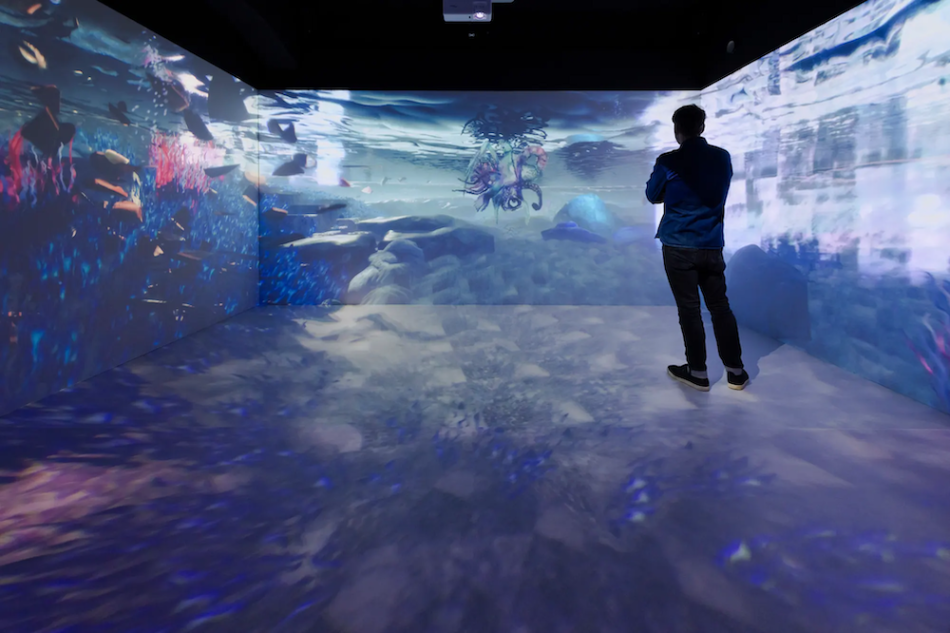
For instance, in Ent- (2022) I animated hybrid forms using entanglement data. These bodies quickly became unbounded, continuously shifting, cycling through abstractions that never settled long enough to become fixed images.
Talking about this type of abstraction often felt challenging. How do we speak about art that holds content not recognisable to human brains?
Especially when audiences often desire a classical anchor: a recognisable form or story to situate themselves? In Ent-, I referenced Bosch’s Garden of Earthly Delights as a container to orient viewers.
However, I’ve come to appreciate the lack of adequate language as a feature rather than a hindrance.
Like my experiences after extended periods of meditation or during altered states, my artistic practice surpasses the classical limit.
Quantum-only ontologies therefore begin from a simple, radical position.
What does it mean if classicality never enters?
What if superposition and entanglement continue uninterrupted?
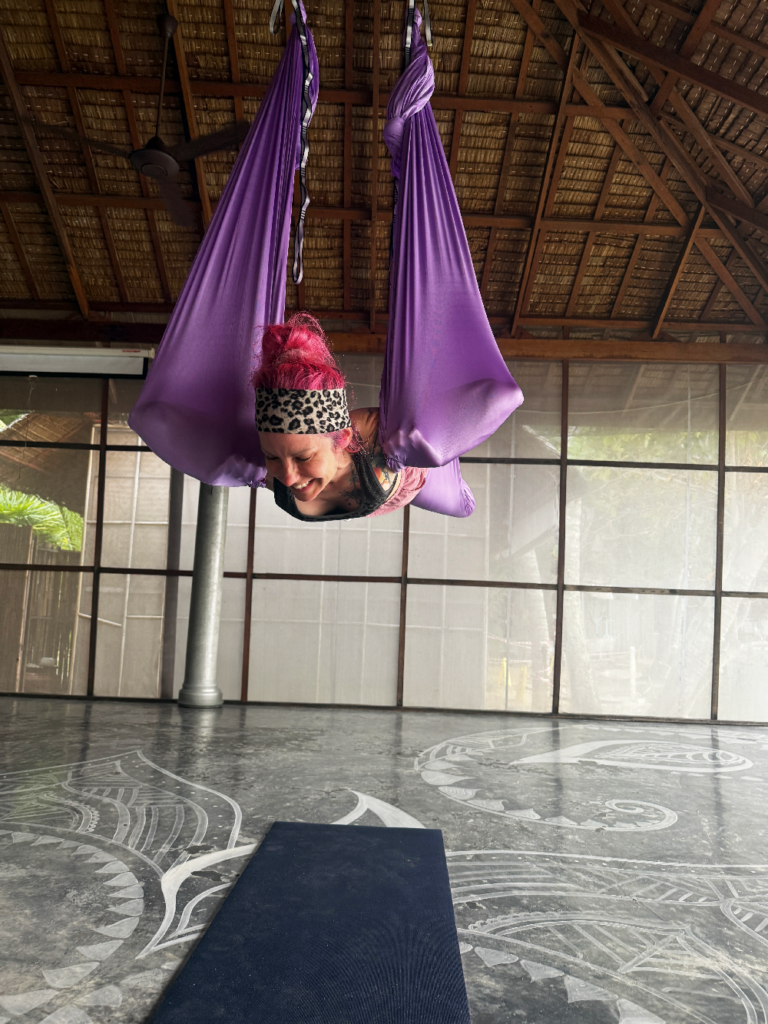
In Thailand, I tried aerial yoga for the first time. It reminded me that going back to not-knowing is both humbling and freeing. I decided to try to approach my established, regular yoga practice in that way too, with a beginner’s mind set: no narratives and no expectations.
For me, a quantum-only experience is a little like a beginner’s mindset. There is some sort of being, but without narrative, a recognised routine or even memory. So, instead of fixing things, what does it feel like if we stay within the layers of possibility of superpositions and quantum entanglements?
This shifts me into different territory than Barad.
Like a beginner’s mindset, free from fixed facts and ego-based expectations, art based on a quantum-only ontology lets us remain in the unresolved. Whereas Barad helps us understand how fixed expectations are formed, how ‘facts’ emerge and what is erased when this occurs.
In quantum-only ontologies, there is no record keeping so there can be no erasure. As I have excluded classicality, there are no rigid boundary making practices so meanings do not need to be resolved. For me, visual translations of Barad often miss the layering of different intersecting realities that come from superposition and quantum entanglement.
Instead, in a quantum-only ontology contradictory realities pulsate together and apart. But they do not compete for selection. Like the breath connecting body and mind, they remain present together, shaping one another through relation.
The present is not a point on a single line. Progress can never be linear. Time does not move cleanly from past to future. Instead, it interferes, loops and carrying traces of all paths.
Quantum-only ontologies are dense interference patterns of many temporalities acting at once.
This is the start of what it means to feel experience before it becomes legible. This is what I call Quantum Feeling.
In 2026, Quantum Queeries will take a deliberately beginner’s stance, opening spaces to think through quantum-only experience from artistic, philosophical, political, and economic perspectives.