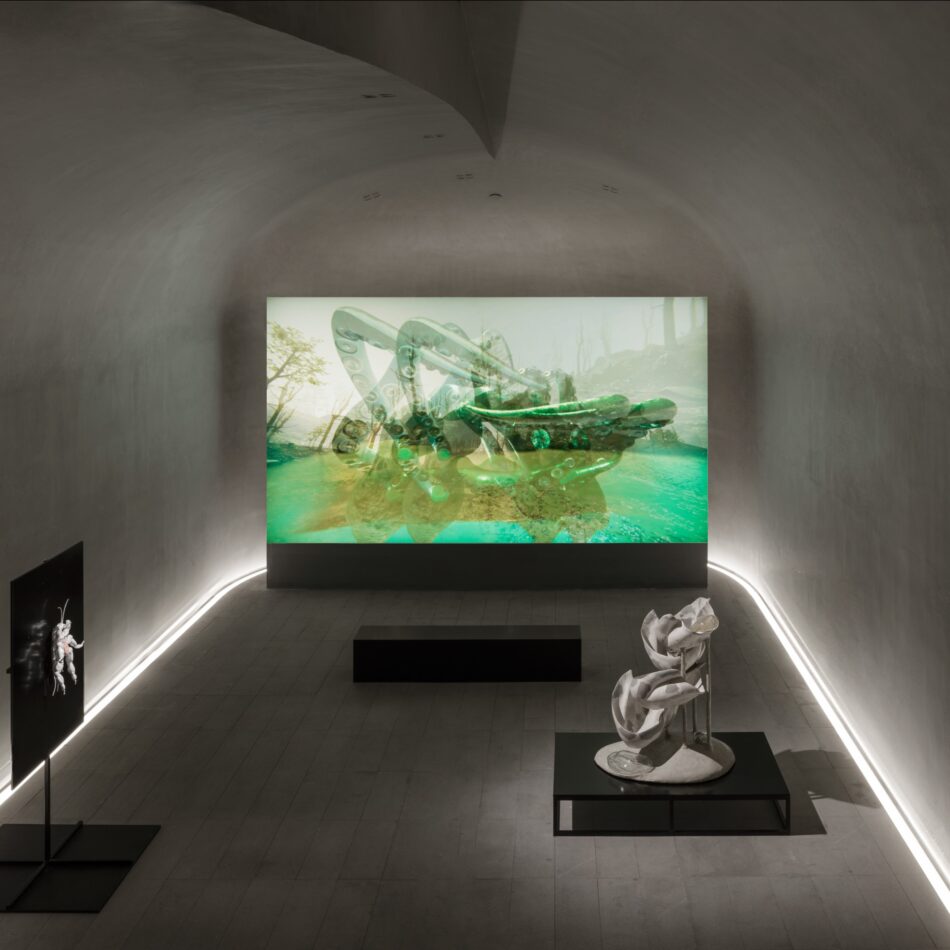
Q is for Climate (?), 2023, at HERMIT space, MAHA Art Centre, Beijing, 2024.
How is quantum computing different to digital computing?
I often say quantum is non-binary (all possibilities happening at once) – versus digital which is binary (like a switch, on OR off). One option, then done.
Put scientifically, the non-binary nature of quantum computing comes from:
1) quantum superposition – the ability for one thing to be in two (or more) contradictory states at once
2) quantum entanglement – a deep correlation between two (or more) entities, such that it becomes impossible to speak of, or retrieve, an individual entity.
Should genuine quantum computer art therefore make explicit use of superposition and entanglement to differentiate it from art made with digital tools?
– If we could see into the quantum world, what would superposition and entanglement look like?
– What do two contradictory realities look like, when they exist in quantum forms – in the same place, making use of the same material, at the same time?
– If one thing is in two states at once, is it like seeing double (e.g. after too many drinks)?
– What does it look like if entities are irreducibly connected? Their boundaries blurred even if they are really far apart?
– If we can no longer speak of the possibility of depicting individual entities, what does this mean for representational art?
These are some of the questions I’ve been thinking about recently as I make new works with quantum-digital tools.
Either way, quantum computing art is important.
Its layering of different realities suggests how multitudes of perspectives can co-exist all at once – in the same place, at the same time.
Given the current polarisation in politics or the dominance of humankind over nature, what could be more important than new equitable, plural models of the world?