Beyond Barad Part Two: Paradoxical Unfoldings
Here I revisit my reflection on Karen Barad’s hybrid quantum-classical philosophy from Beginner’s Mindset: Beyond Barad & Quantum-Only Ontologies, this time focusing on the paradox of creating art with quantum-only ontologies
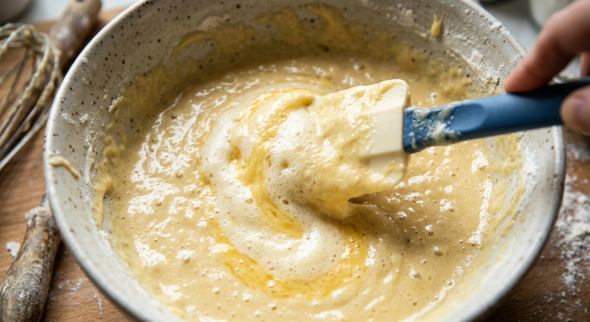
Eggs being folded into batter.
The etymology of the word fold comes from Old English and Proto-Germanic, meaning to bend, to wrap and also to multiply.
We fold clothes and sheets before putting them away. We fold eggs into batter when baking. Gravity folds space and time. Folding is about multiplying and layering, evoking the parallel states of quantum computing.
We say someone has folded when they concede, a kind of collapse. It suggests contortion. Yet I fold and contort my own body when I feel expansive, when I dance. My favourite nightclub, FOLD, holds this tension in its name. When something folds, multiplicity and contortion are present at once.
A complex origami form is folded into multiple dimensions. Its complexity increases as it comes to exist across many intersecting planes. To unfold an origami sculpture is to flatten it, reducing its multiplicity to a single surface.
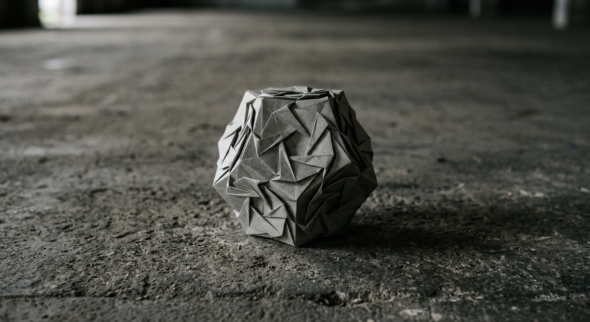
Render of complex origami shape.
If quantum reality is folded and folding, then bringing it into this reality is a process of unfolding – a flattening.
My previous text Beginner’s Mindset: Beyond Barad & Quantum-Only Ontologies (un)folded ways to move beyond even the most expansive classical relational ontology and into something irreducibly quantum.
A quantum-only ontology is a folded, folding multiverse of entanglements and superpositions, where there is no collapse and no unfolding. In this framing, there is no underlying classical substrate waiting to be revealed. In the future, this will be the entangled reality inside an error-corrected quantum computer before the computation is read out.
Yet, as with quantum computational read-out, there is always a necessary translation between this quantum-only state and the classical structures we inhabit and build with.
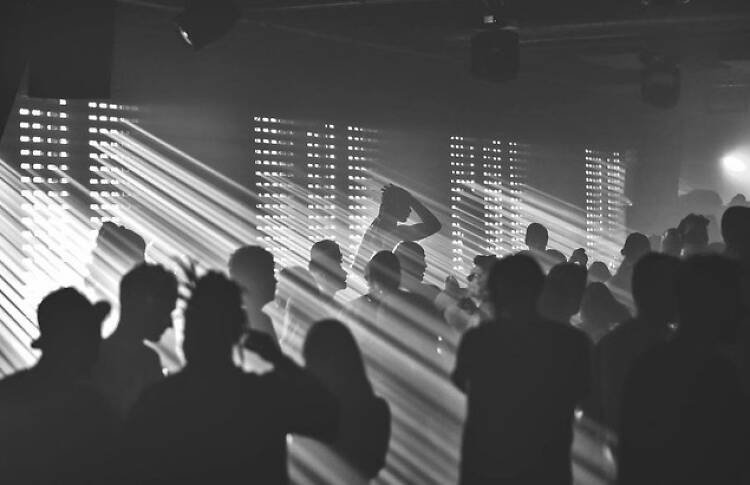
Inside FOLD club, London.
This is paradoxical, given that I insist my art is based upon quantum-only ontologies.
Quantum states are not objects that can simply be extracted or displayed. They do not sit as superpositions or entanglements waiting to be found. They exist as potentials of all configurations mutually contradictory to us: up AND down, left AND right, dead AND alive.
As Barad notes, in quantum physics the act of looking is not neutral. It determines which of these configurations exists.
Any translation of quantum into image, sound, or digital form is an unavoidable flattening.
Quantum states occupy dimensions that exceed our three spatial dimensions and linear time. What we encounter in this reality is never the totality, but a partial trace shaped by how we choose to interact with a quantum-only state.
I think of this process of translation as unfolding. When unfolded, the quantum state flattens into a surface that can be read, at the cost of losing its wild nonlinear timelines and layered entanglements.
Our world operates through these flattened illusions. For Barad, how events ‘unfold’ into a single timeline and become fixed, whether in geopolitical conflict, the climate crisis or personal memory, is precisely the point of their work.
In any quantum artwork, unfolding is a technical necessity. It is the mechanism through which quantum is made to appear. However, it is also the point at which quantum multiplicity is most at risk of being lost… like in Barad’s reading (where they call it erasure), unless we are careful.
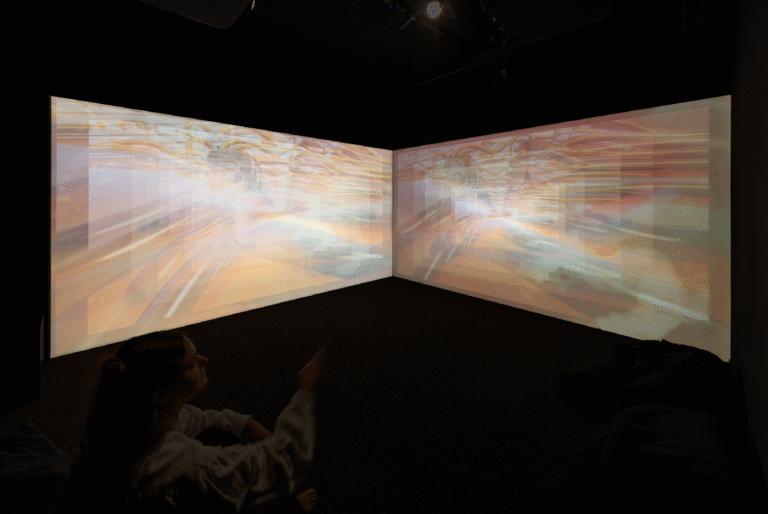
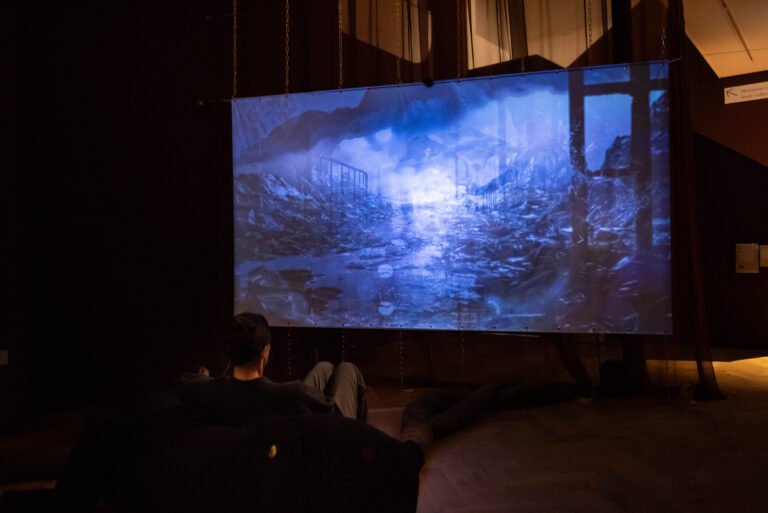
Installation view: Libby Heaney, Nibble My Multiverse, 2025, at HEK, Basel. Photo: Franz Wamhof.
Re-folding Quantum
There is never only one way to unfold. There are infinitely many possible flattenings of the same quantum “origami” structure, each revealing different alignments and concealing others. By using techniques scientists use to explore quantum-only ontologies, my digital-quantum environments can hold multiple unfoldings at once rather than committing to a single flattening like Barad.
In works like Nibble My Multiverse and Shadowscapes (Emotional Dumping Ground), different timelines, perspectives and contradictory states coexist without resolving into one coherent world. Audiences encounter layered quantum multiverses where various foldings shift in and out of being.
On the other hand, Barad’s agential cut unfolds a specific reality and they discuss the ethics this entails.
My approach swerves that final collapse. I re-fold, re-layer, re-entangle, and re-non-linearise quantum existence, allowing contradictory configurations to remain active and perceptible together.
Paradoxical unfoldings matter because they allow complexity to remain without forcing resolution. They open space for contradictory truths and contradictory temporalities to coexist. In a world that usually needs clarity and certainty, I believe this is a radical act.
Folded quantum fields of difference allow us to feel deep nonlocal entanglements without reducing them and to remain within what cannot be fully known.