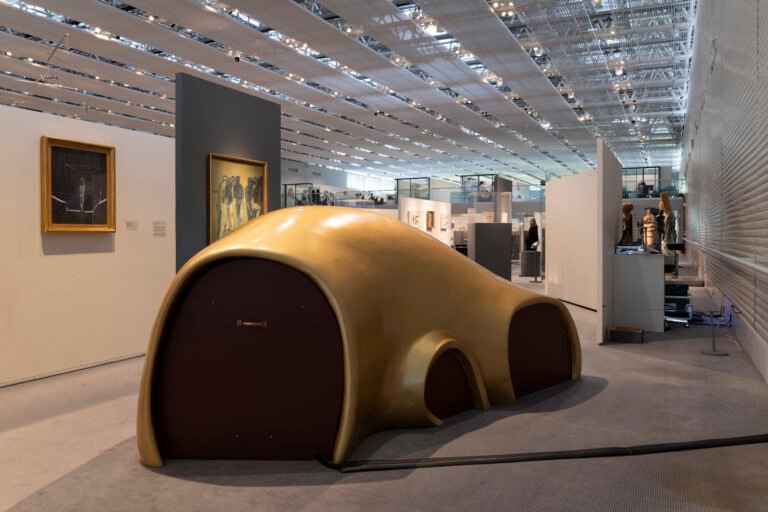
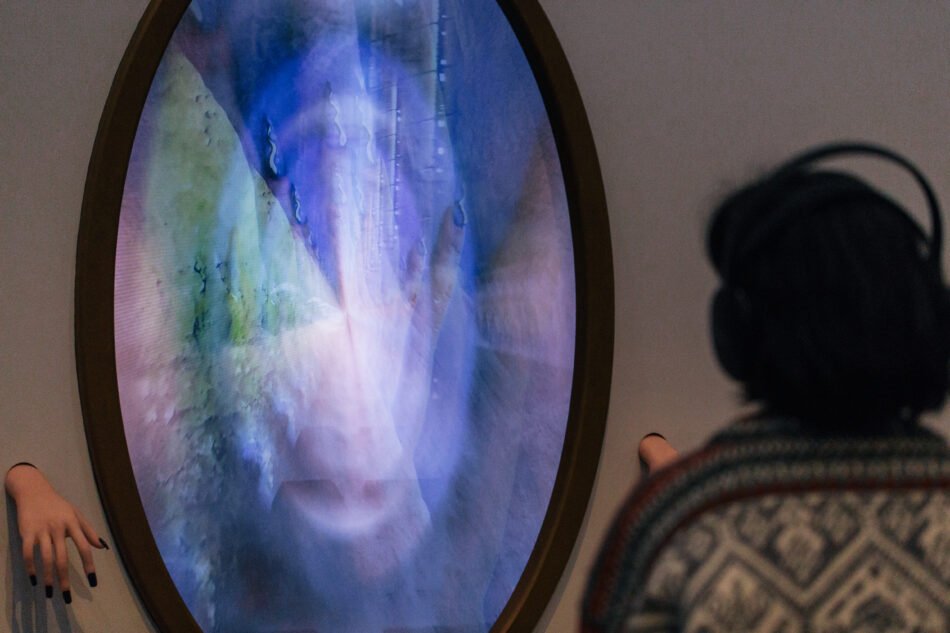
Installation view: Libby Heaney, Life in the Multiverse, 2026, Sainsbury Centre, Norwich, 16th May – 4th October 2026. Photo: Kat Mager.
Life in the Multiverse, 2026, two channel interactive realtime quantum multiverse
with stereo sound, evolving 18min30 loop.
Life in the Multiverse is a two-channel, interactive audio-visual installation commissioned by the Sainsbury Centre, Norwich, for its What is the Meaning of Life? season (15 May to 11 October 2026).
The work invites audiences to consider a meaningful life as one deeply rooted in connection. Using superposition and entanglement via quantum computing, Life in the Multiverse goes beyond the self as an individual, to one which is unbounded, paradoxical and intertwined with other humans and other-than-human beings. Audience members become part of this: they see traces of themselves on screen and hear themselves echoed within the soundtrack, entangling within the work.
Heaney approaches meaning through both personal and universal perspectives, layering fragments of the everyday, bodily experiences, moments of touch, dreams and memories to imagine life as fundamentally interconnected across human and non-human worlds.
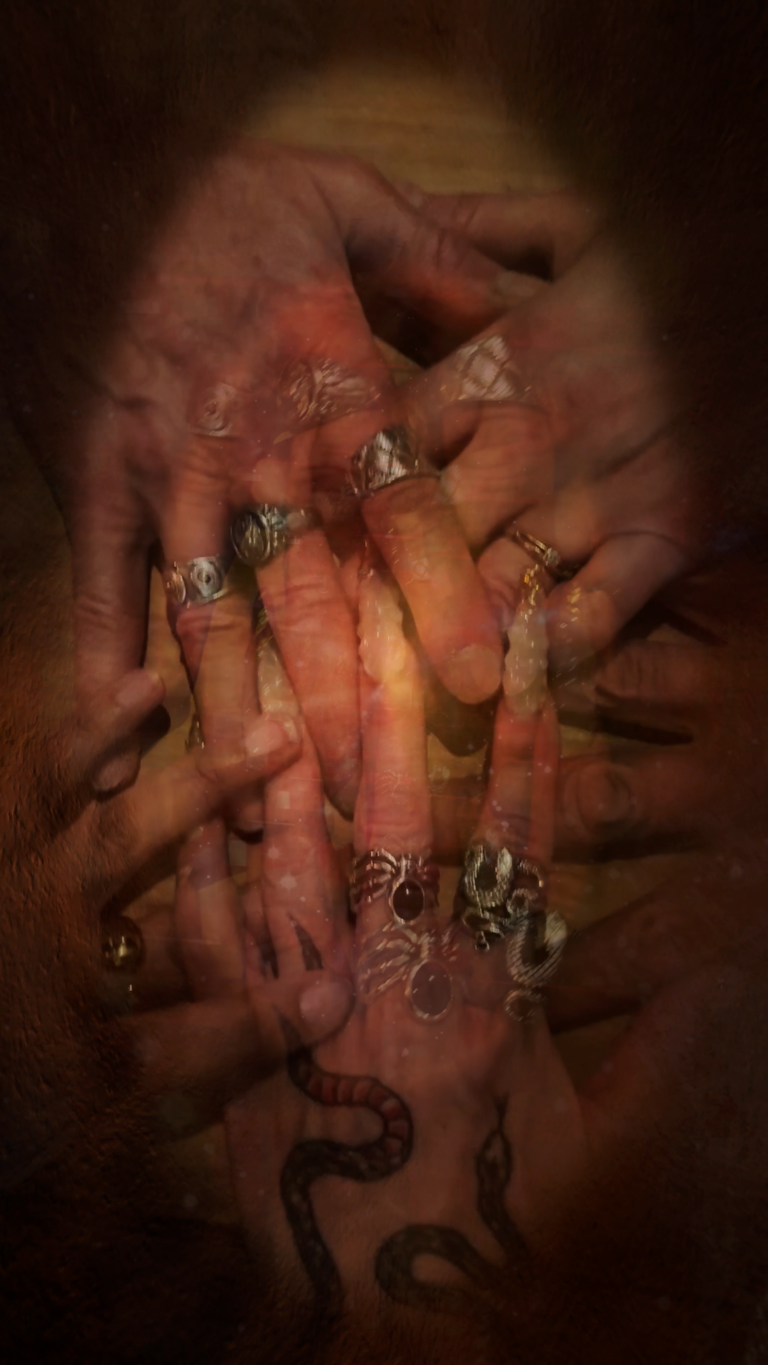
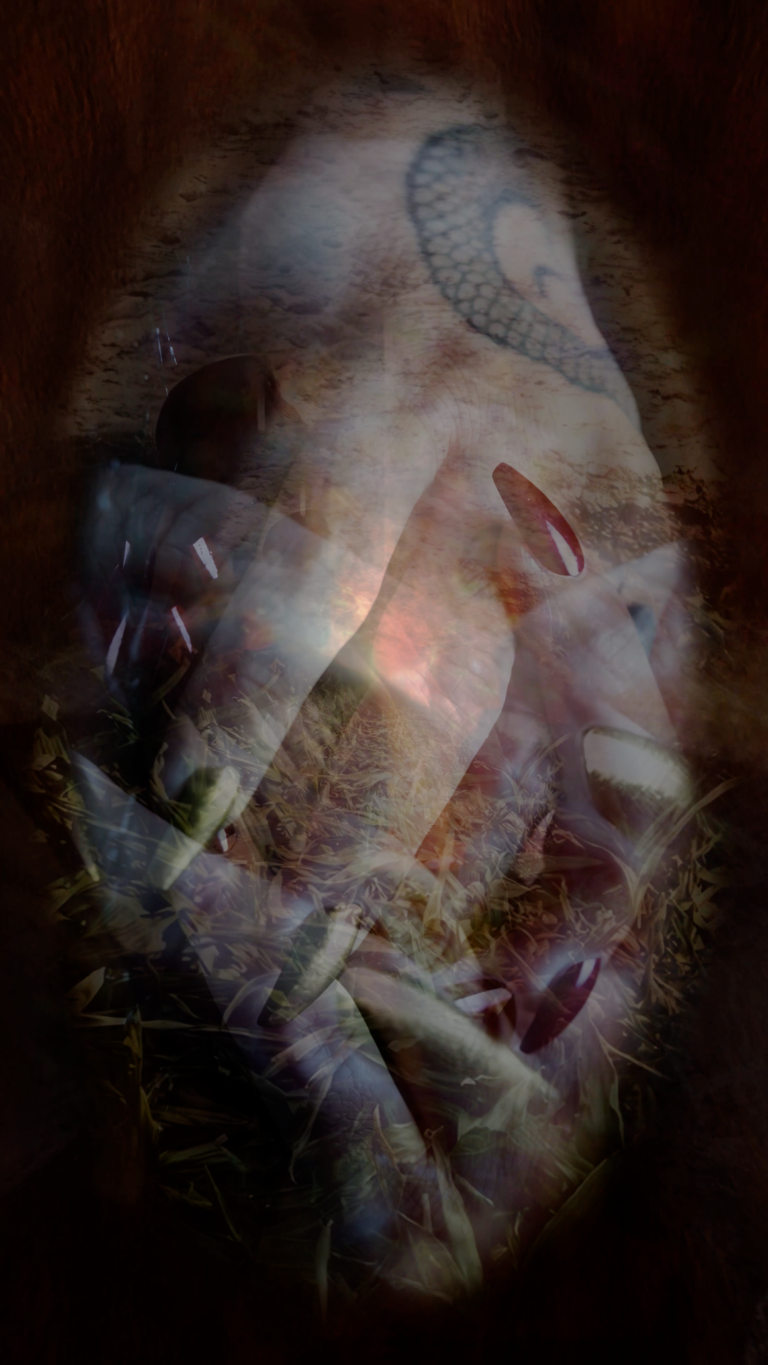
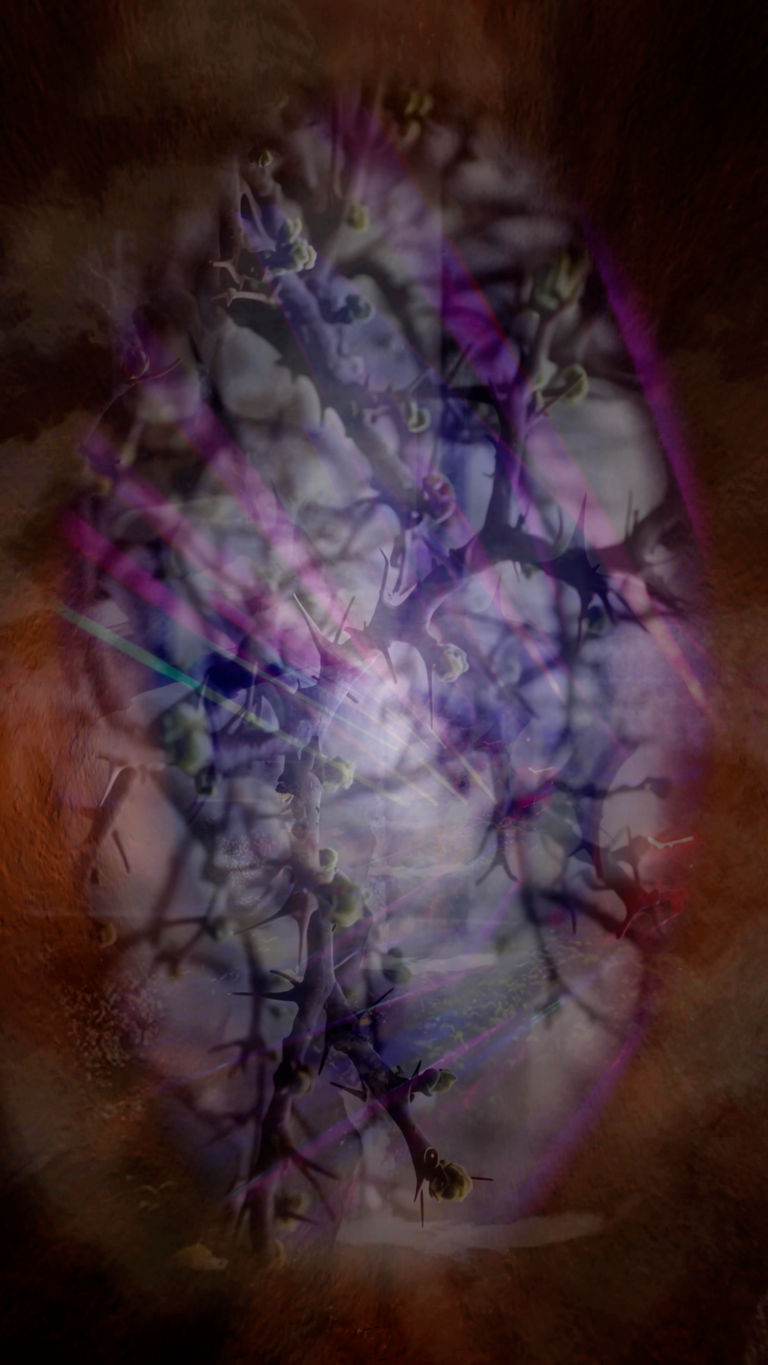
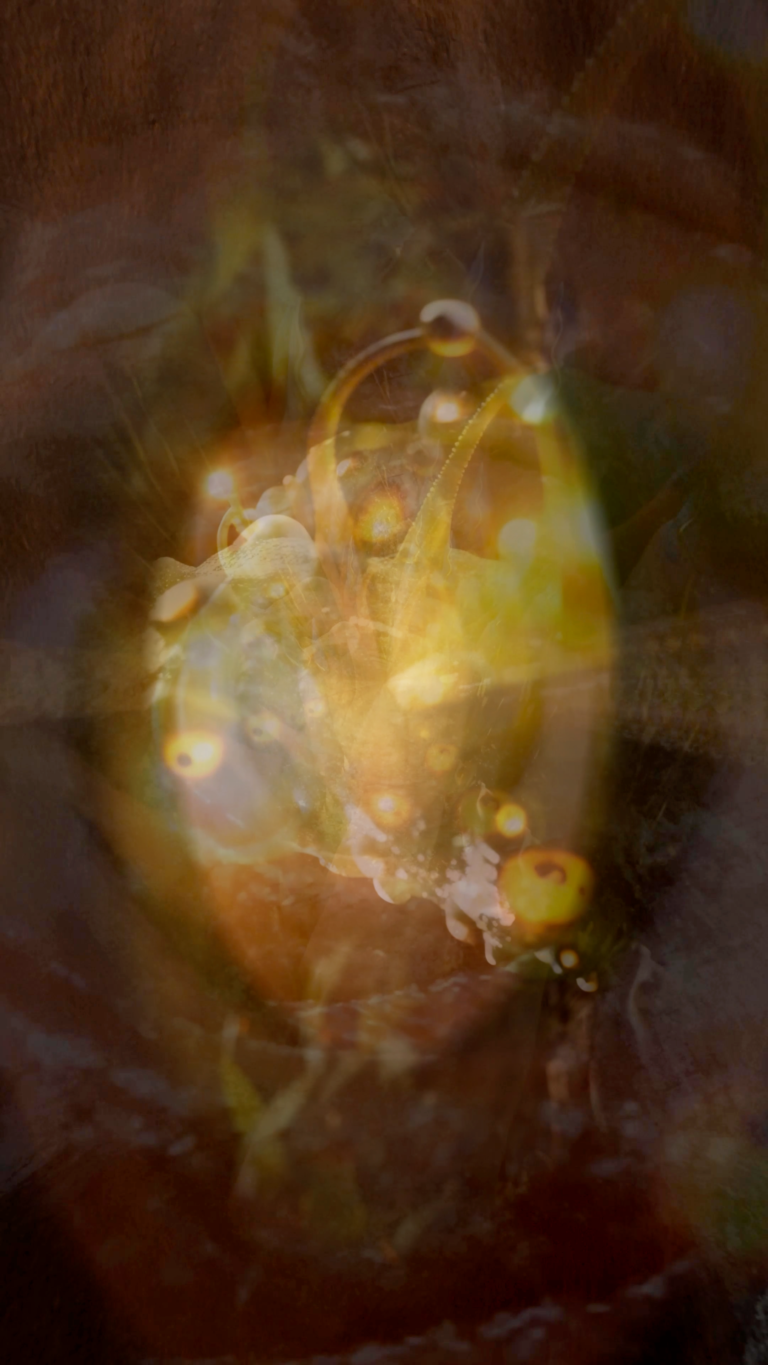
Selected clips from Life in the Multiverse, 2026 rendered from the real-time interactive version. The moving images are generatively composed through patterns of quantum superposition and entanglement using Heaney’s bespoke quantum computing code, revealing what quantum non-linear time actually looks like. Courtesy of Libby Heaney.
Within the installation, audiences encounter superposed video fragments that act like glimpses into the unconscious or fleeting somatic sensations. Never fully visible, these fragments invite viewers to reflect on their own connections, embodiments and relationships to the world around them. Like the self, the work continually recomposes through wave-like quantum code rather than randomness, combined with asynchronous video loops that only fully repeat every 155 days.
Much of the material is drawn from Heaney’s personal archive, documenting moments of connection and separation from the past four years, while also reflecting on the continuing presence of her sister, who died by suicide in 2019. Layered multiverses emerge briefly before dissolving back into darkness: friends dancing, pets gazing, hands touching, eyes blinking, branches reaching, pieces of fruit nestling together, a stalactite and stalagmite meeting, waves lapping, daffodils jostling, clouds drifting, bodies raving.
Installation view: Libby Heaney, Life in the Multiverse, 2026, Sainsbury Centre, Norwich, 16th May – 4th October 2026. Photo: Kat Mager.
The installation also incorporates AI-generated imagery inspired by encounters with the Sainsbury Centre’s Living Art Collection. Unique among museums, the Sainsbury Centre considers its artworks to be alive and animate. As part of her research, Heaney asked selected artworks about the meaning of life through meditation, somatic encounters and dreams, including spending a night sleeping on the museum floor next to a sculpture Dream Amphora by Jean Arp.
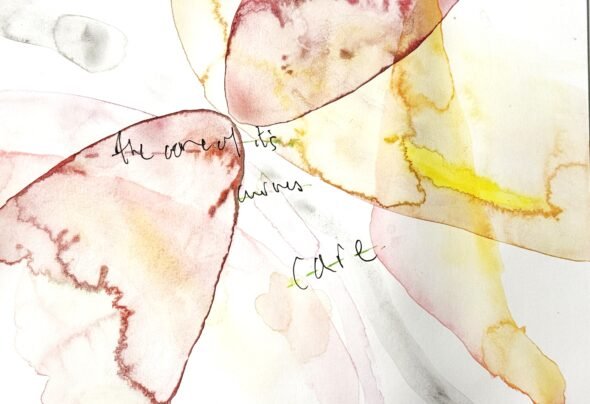
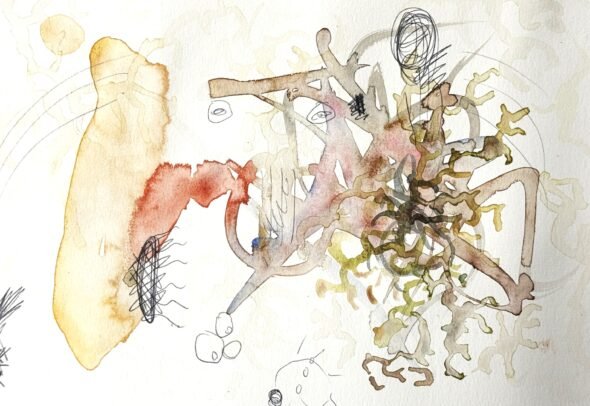
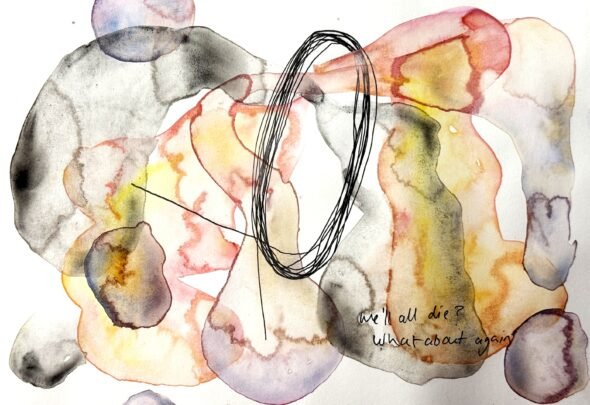
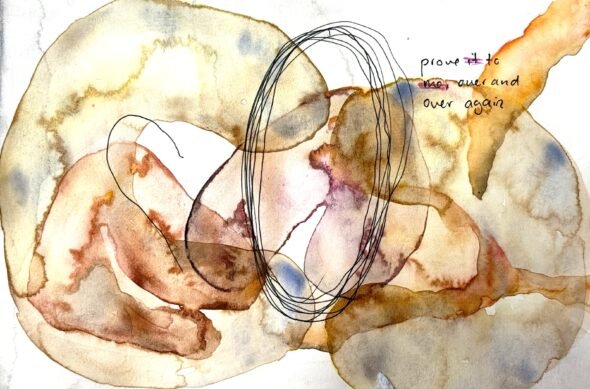
Over a prolonged period, she developed a close relationship with Jean Arp’s Dream Amphora through touch, observation, meditation and sleep. These encounters were documented through a series of small abstract and diagrammatic watercolours and drawings. Sensations of heat in the body might appear as red scratches, while circular dream imagery became black looping scribbles. These studies later formed source material for abstract videos of human-artwork connection within the final installation.
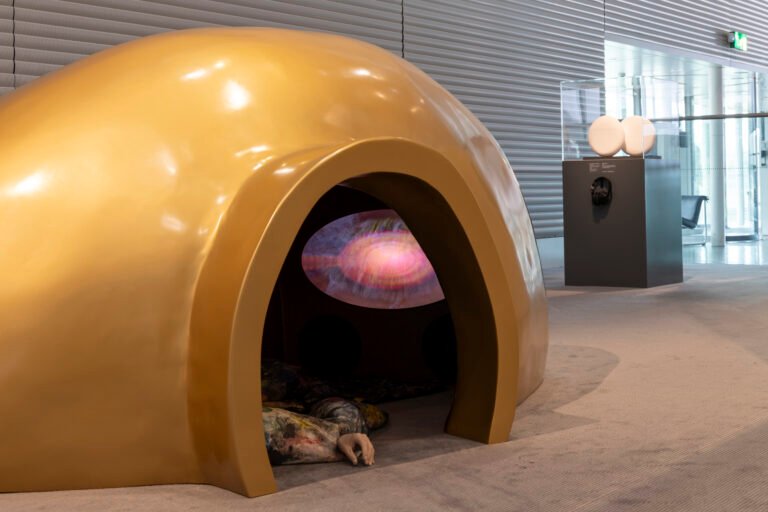
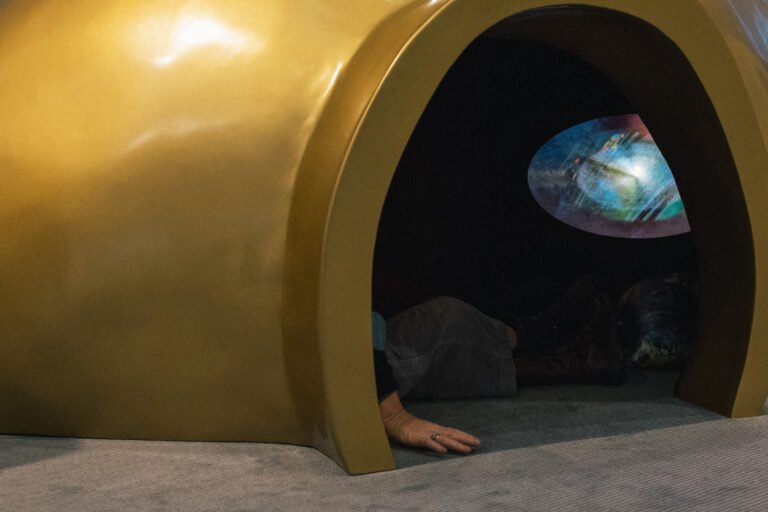
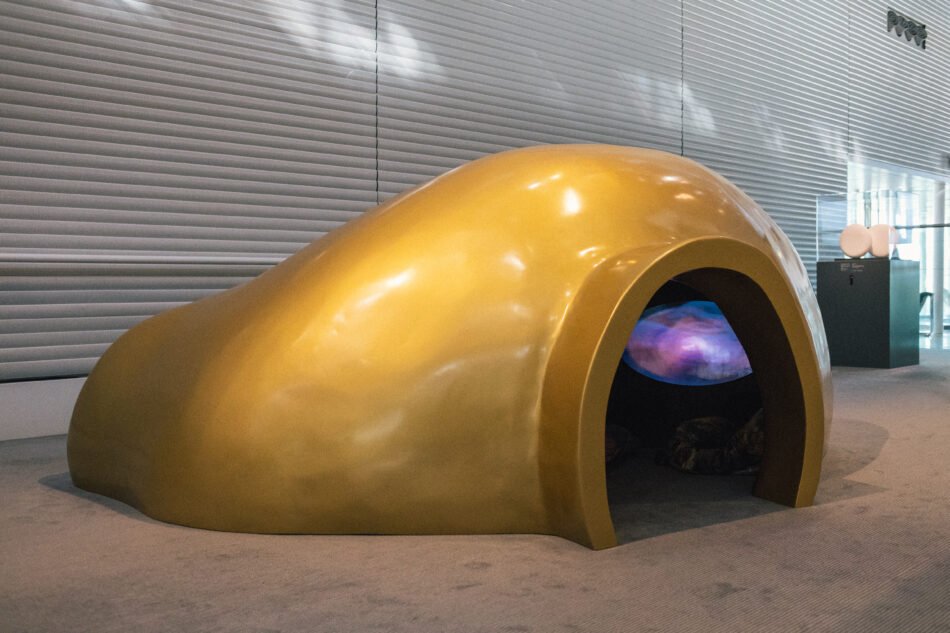
Installation view: Libby Heaney, Life in the Multiverse, 2026, housed inside giant replica of Jean Arp’s Dream Amphora, 1941. Sainsbury Centre, Norwich, 16th May – 4th October. Photo: Kate Wolstenholme.
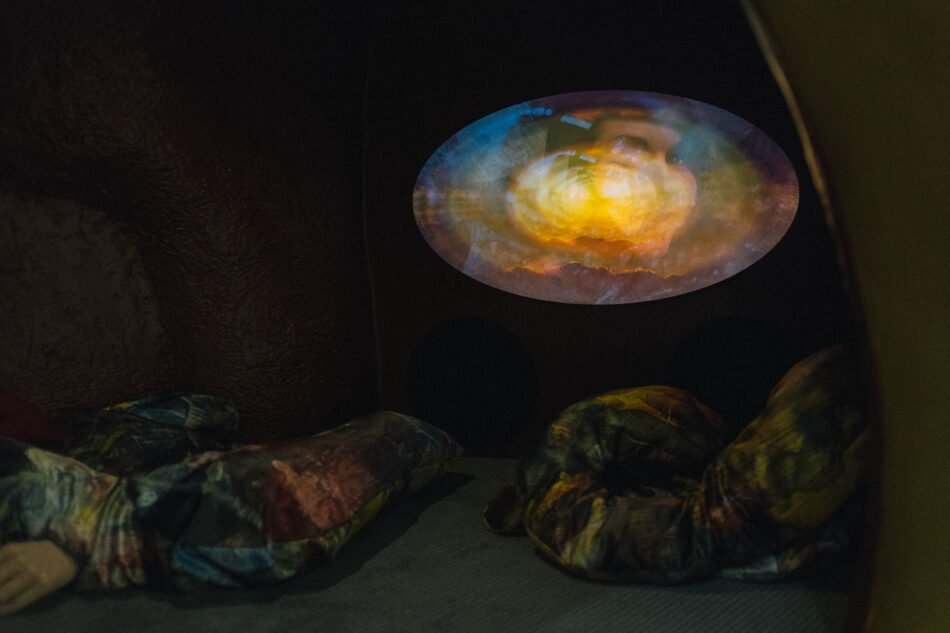
In the Sainsbury Centre presentation, one screen is housed within an enlarged replica of Dream Amphora laid on its side. Visitors are invited to crawl inside and experience the work from within, entering a different perceptual realm and forming their own relationship with the installation.
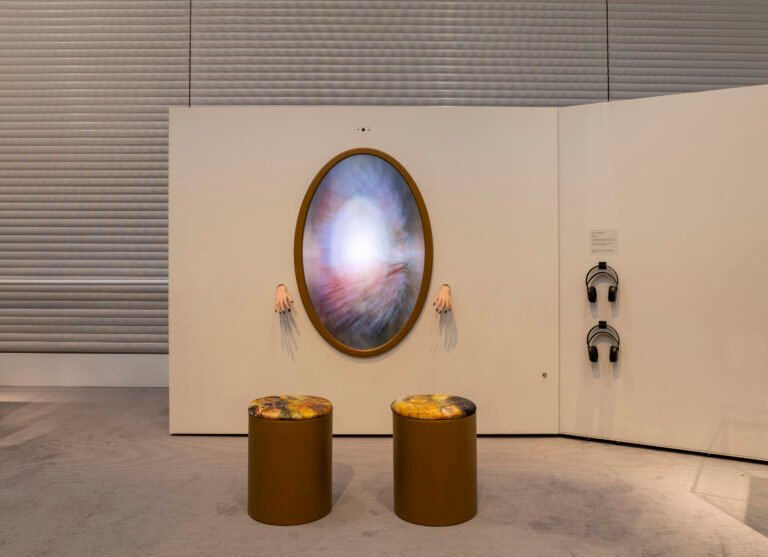
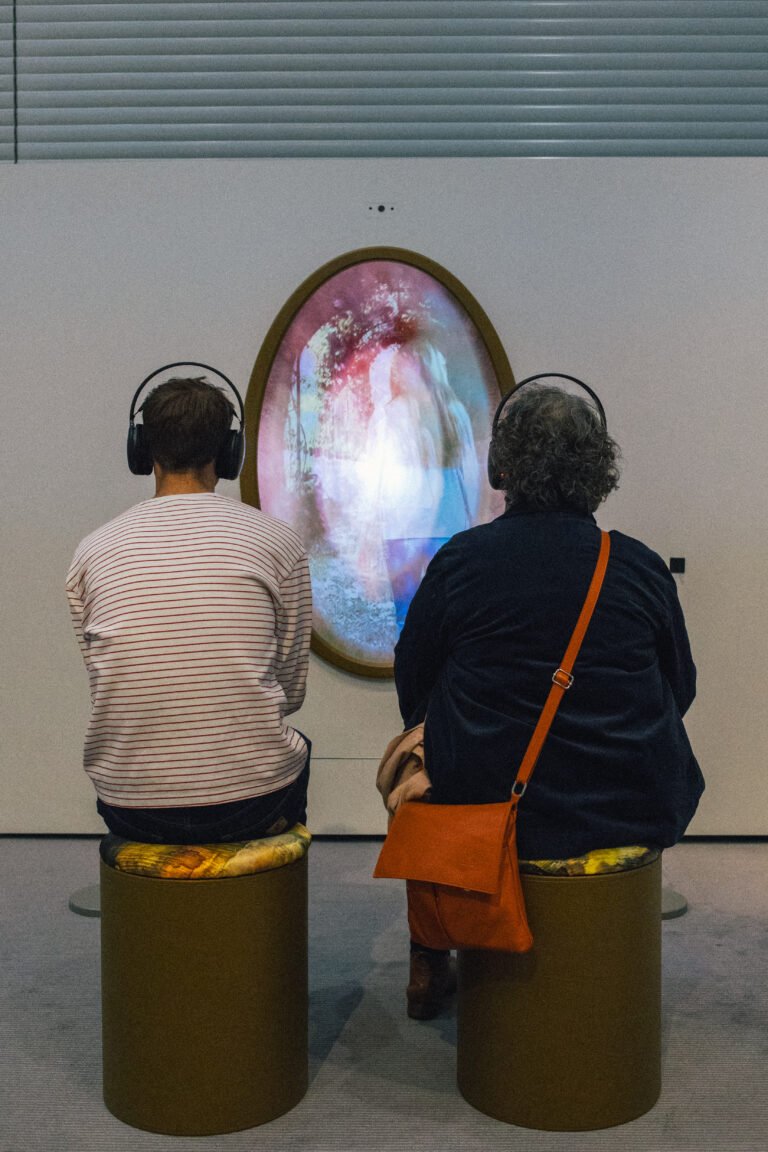
The two screens are positioned in separate locations throughout the gallery and actively respond to the presence of viewers. Using a live webcam and AI-based facial recognition, the system detects when someone enters the vicinity of either work. When visitors speak near one of the screens, they hear their voices, and sometimes the voices of people at the other location, softly echoed back. Likewise, viewers may catch fleeting, ghost-like glimpses of themselves or others appearing within the imagery. These non-local traces become entangled within the shifting audio-visual environment, extending the work’s broader exploration of connection, embodiment, and relationality.
Installation view: Libby Heaney, Life in the Multiverse, 2026, Sainsbury Centre, Norwich, 16th May – 4th October 2026. Photo: Kat Mager.
Inspired by the work’s fluidity, layers and memories, the soundtrack provides a point of continuity within an ever-shifting multiverse. While the videos continuously recombine, the sound unfolds through an 18-minute, 30-second composition before returning to its beginning.
Underlying the installation is Heaney’s ongoing exploration of quantum-only ontologies. Drawing on reconstruction techniques that attempt to imagine the quantum world prior to collapse into classical reality, she references the Many-Worlds interpretation of quantum mechanics, which she refers to as the multiverse.
According to this interpretation, all possible outcomes of quantum events continue to exist as branches of parallel and often contradictory worlds. Viewed collectively, there is no collapse and return to a singular classical reality. Instead, each branch persists, inaccessible to the others.
Installation view: [Left] Jean Arp, Dream Amphora, 1941. [Right] Libby Heaney, Life in the Multiverse, 2026, housed inside giant replica of Arp's Dream Amphora. Sainsbury Centre, Norwich, 16th May - 4th October 2026.Photo: Kate Wolstenholme.
Installation view: Libby Heaney, Life in the Multiverse, 2026, housed inside giant replica of Arp's Dream Amphora. Sainsbury Centre, Norwich, 16th May - 4th October 2026.Photo: Kate Wolstenholme.
Installation view: Libby Heaney, Life in the Multiverse, 2026, housed inside giant replica of Arp's Dream Amphora with soft sculptural seating. Sainsbury Centre, Norwich, 16th May - 4th October 2026.Photo: Kate Wolstenholme.
Installation view: Libby Heaney, Life in the Multiverse, 2026, housed inside giant replica of Arp's Dream Amphora with soft sculptural seating. Sainsbury Centre, Norwich, 16th May - 4th October 2026.Photo: Kate Wolstenholme.
Installation view: Libby Heaney, Life in the Multiverse, 2026. Sainsbury Centre, Norwich, 16th May - 4th October 2026.Photo: Kate Wolstenholme.
For Heaney, the multiverse provides a useful metaphor for collective human and non-human subjectivities. The inner world of each individual is like a branch of the multiverse: a unique realm of sensations, memories, desires, and experiences that can never be fully accessed by others.
The idea then becomes recursive. The inner life of each subject is itself a multiverse, populated by conflicting emotions, competing narratives, hidden desires, true and false memories, dreams, shadows, and multiple versions of self. Any apparently stable identity is only a temporary appearance, much like a single branch within a larger quantum reality.
The meanings generated by an artwork form another multiverse. Every viewer encounters a different work, producing countless coexisting interpretations. In this sense, the death of the author becomes the birth of a multiverse.
Although these worlds remain partially inaccessible to one another, they are never fully separate. The branches of the multiverse continuously sense, affect, and shape one another. Direct access may be impossible, yet entanglement remains.
Vertical still image of Life in the Multiverse, 2026. Courtesy of Libby Heaney.
Vertical still image of Life in the Multiverse, 2026. Courtesy of Libby Heaney.
Vertical still image of Life in the Multiverse, 2026. Courtesy of Libby Heaney.
Vertical still image of Life in the Multiverse, 2026. Courtesy of Libby Heaney.
Process
Heaney traced bodily and emotional connections with humans and other-than-humans through a series of drawings and watercolour paintings. The aesthetics and content of these informed her connected watercolour paintings and the afore described moving image work.
Heaney’s sensorial research: four watercolour paintings reflecting on Heaney’s experiences with the Living Art at Sainsbury Centre. Courtesy of Libby Heaney.
Heaney’s sensorial research: four watercolour paintings reflecting on Heaney’s experiences with the Living Art at Sainsbury Centre. Courtesy of Libby Heaney.
Heaney’s sensorial research: four watercolour paintings reflecting on Heaney’s experiences with the Living Art at Sainsbury Centre. Courtesy of Libby Heaney.
Heaney’s sensorial research: four watercolour paintings reflecting on Heaney’s experiences with the Living Art at Sainsbury Centre. Courtesy of Libby Heaney.
![Installation view: [Left] Jean Arp, Dream Amphora, 1941. [Right] Libby Heaney, Life in the Multiverse, 2026, housed inside giant replica of Arp's Dream Amphora. Sainsbury Centre, Norwich, 16th May - 4th October 2026.Photo: Kate Wolstenholme.](https://libbyheaney.co.uk/wp-content/uploads/2026/06/Life-in-the-Multiverse_Sainsbury-Centre.-Photo-Kate-Wolstenholme_16-768x512.jpg)