
Our Shadowy Times: Indeterminacy, Multiplicities and Entanglements
I discuss the contextual framework of my solo exhibition Shadowscapes, touching on Jungian psychology, the shadow self and how these entangle with quantum.
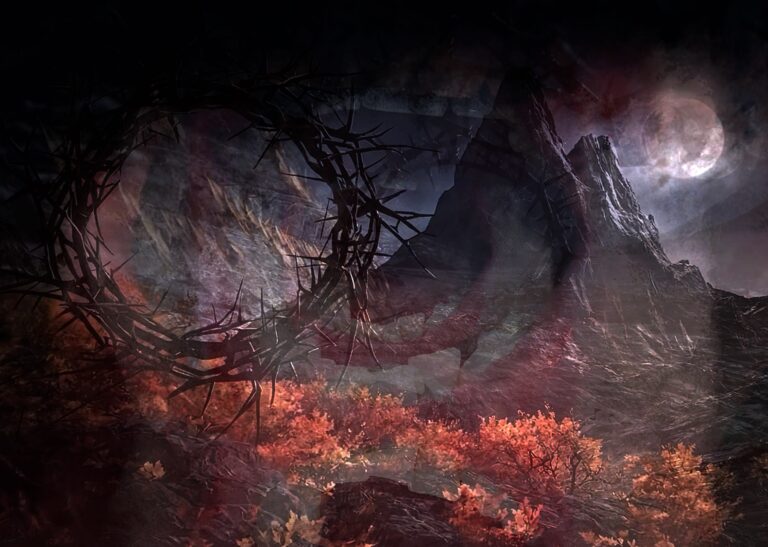
In this age defined by hyper-visibility, where literally everything is captured, posted, optimised and quantified, the idea of the shadow – the hidden, repressed parts of ourselves – might feel radical.
Does looking toward shadow resist the flattening effects of constant exposure?
I’m not sure, as authenticity online – revealing one’s ‘hidden’ self – has certainly become currency for attention, fixing shadow into a flat-packed marketable object.
Shadow does, however, invite us to inhabit uncertainty, fluidity and multiplicity, which are also quantum ideas resistant to visibility (when left wild).
Much like how quantum underpins the flattened, macroscopic world, shadow also allows us to acknowledge how much of our experience lies beyond the limits of comprehension and social acceptability.

JMW Turner, Rocky Bay With Figures, 1828.
I’ve been listening to the podcast This Jungian Life for years, and elements of Jung’s work inform the psychological aspects of my practice. In Jungian psychology, the “shadow” refers to the parts of the self that are repressed, hidden or disowned.
Moreover, like shadow, I see the “self” as quantum. Not bounded and individual like in most of western philosophy, but rather layered, contradictory, unbounded and deeply entangled to other humans and non-humans.
Therefore, in a world fractured by polarisation, algorithmic bias and ecological neglect, our unbounded shadows manifest everywhere: purring within the politics of purity, licking the inside disinformation loops, and smeared across the persistent exploitation of bodies and environments that are deemed expendable.
Turner’s paintings, particularly the ones I’ve selected for Shadowscapes, which all feature Turner’s uncanny depictions of human bodies, can be read as early meditations on this dynamic.
His canvases are spaces where matter dissolves and reconstitutes like quantum particles. There are no depictions of bounded objects – neighbouring forms blend into each other. When you get close and observe, visibility collapses into its own negation.
Any apparent solidity falls apart.
Re-reading Turner through contemporary lenses, Shadowscapes asks what it means to read shadow through quantum indeterminacy: to explore the unseen as both absence or lack and at the same time as a nonlocal field of potential, flux and entanglement, horizontally.
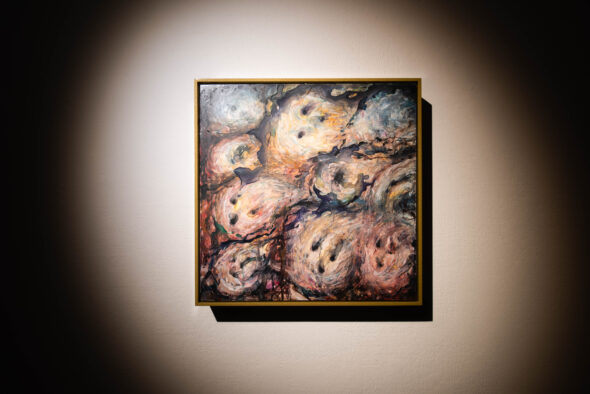
Libby Heaney, Golden Shadow (Hips), 2025, watercolour and varnish on wooden board, 30x30cm.
In quantum systems, visibility and measurement are not neutral acts! Like quantum particles, personal shadows can never be directly observed. If we think we have a good grip of our shadow, it is likely oozing out in another direction.
Measurements irreversibly shape the very thing being observed. The same is true socially and psychologically: what we choose to see, and what we refuse to see, start to construct the artificial boundaries of our collective reality.
By engaging with shadow, my own personal shadow and our collective ecological shadow, we begin to notice the layered, blurry feedback loops between self and system, psyche and world.
The amorphous bodies that emerge in this exhibition are to be both exorcised and befriended – or perhaps simply accepted, weakening their overall potency. They are guides through the subconscious strata of entangled contemporary lives, signalling the urgency of integration rather than denial.

Detail of exhibition design from Shadowscapes, 2025.
Considering shadow today means reckoning with waste, both material and psychic. The discarded, the polluted, the obsolete and the unseen are all forms of the shadow in physical form. My interactive work, Emotional Dumping Ground, depicts litter within psychic landscapes inspired by Turner’s paintings and based on my own sketching. Powered by quantum data and including a responsive narrative, the work positions audiences as active agents within this entangled field. Their movements and shadowy visibility illuminate, distort and reveal fragments of projected shadow, making tangible the reciprocal nature of perception.
I must stress, to engage with shadow is not to dwell in darkness.
This initial reaction flattens the fluidity and entanglement of the hidden and unseen. Rather, an engagement with shadow widens the spectrum of what can be felt and imagined across both personal and collective.
Engagement with shadow and quantum are ethical, aesthetic and ecological practices. They are acts of rebalancing that challenge and entangle binaries of good and evil, clean and dirty, visible and invisible etc.
In the quantum and the psychological alike, reality is not fixed but continuously unfolding through relation. By allowing ourselves to enter the shadowscape – to play, to reflect, to feel both discomfort and curiosity, perhaps we move closer to an unbounded, collective wholeness.
And if not, we can just market our individual shadow sides to gain more attention on social media.